
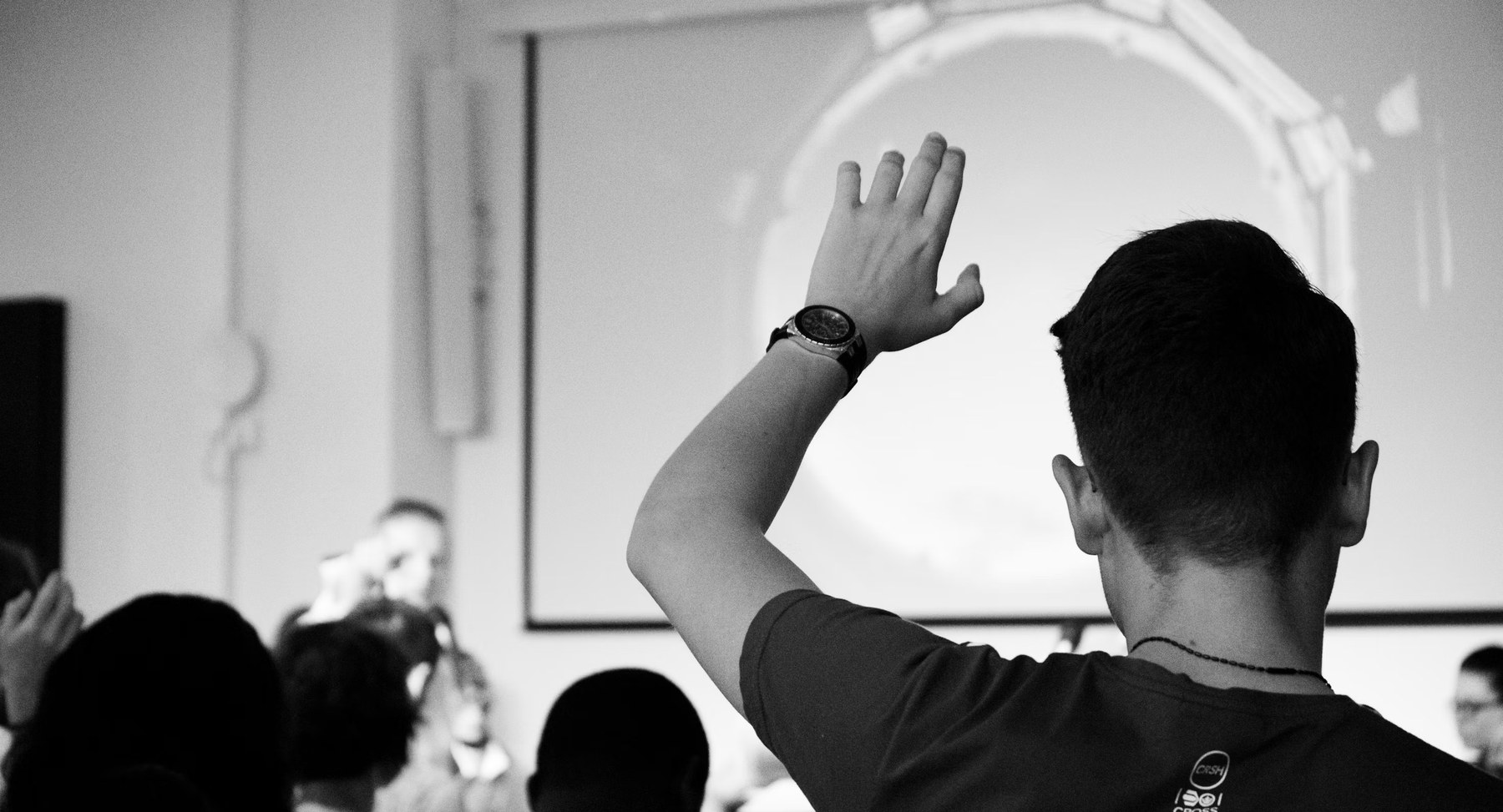
You put your hand up. You said the thing. It came out about seventy percent as clearly as it sounded in your head, there was a pause, the tutor said "mm, yes — and does anyone want to build on that," and the conversation moved on. That was at two o'clock. It is now eleven, and you have replayed it approximately forty times, each time hearing your own voice do the slightly weird thing it did on the third word.
Nobody else in that room has thought about it once since. That's not a comforting platitude — it's a fairly reliable description of what happens next, and it's worth understanding why, because the review you're running is doing you active harm.
The post-mortem is a symptom, not a study session
The thing you're doing has a name in the research on social anxiety: post-event processing. After a situation where you felt evaluated, you conduct a detailed review of your own performance — going over what you said, how you sounded, what people's faces did.
On post-event processing: Clark & Wells, cognitive model of social phobia, 1995; Rachman, Grüter-Andrew & Shafran, Behaviour Research and Therapy, 1999.
It feels productive. It presents itself as learning — I'm working out what to do better next time. But the review is conducted almost entirely on negative evidence, using a recording that's already been edited by your anxiety, and it reliably leaves people feeling worse about the event than they did when they walked out of it. It also strengthens the memory it's rehearsing. You are not learning from the seminar. You are practising a bad version of it.
You're marking yourself on the wrong evidence
Here's the mechanism that makes the review so unfair. You did not experience that moment the way the room did. They saw a person say a sentence. You experienced a racing heart, a hot face, a wobble in your voice, and a sense of the whole room's attention pressing on you. And when you replay it, you replay your version — the one with all the internal noise in it — and mark yourself on that.
But almost none of that was visible. People consistently overestimate how obvious their internal states are to others; the researchers who documented it called it the illusion of transparency. Speakers who felt visibly nervous were rated as much calmer by their audience than they assumed.
Gilovich, Savitsky & Medvec, Journal of Personality and Social Psychology, 1998.
So the wobble you can still hear at eleven at night was, from row three, a person answering a question. The gap between how it felt and how it looked is enormous, and you're the only one who was ever on the wrong side of it.
Add to that the plain arithmetic of a seminar: everyone else was mostly preoccupied with whether they should say something, what they'd say, and whether the thing they said twenty minutes ago was stupid. A room full of people running private audits, each convinced they're the only one.
The real cost is next week
If this were only an unpleasant evening, it wouldn't matter much. The problem is what it does to the next seminar.
After a bad review, the obvious move is to say less next time — contribute only when you're certain, or not at all. And that works: you avoid the risk, you feel relief. But the relief teaches your brain that speaking was genuinely dangerous and you were right to dodge it. So the fear doesn't shrink; it gets confirmed and grows. Meanwhile the gap between what you think and what you've ever said out loud gets wider, which makes the eventual contribution feel even higher-stakes.
This is the actual damage. Not the awkward twelve seconds — the eight weeks of silence that follow it, which cost you the seminar, the tutor knowing who you are, and eventually the reference.
What to do instead
Do one honest review, once, then close it
You're allowed a single pass, and it has exactly two questions: was anything I said factually wrong? and is there one thing I'd do differently? Answer them in a sentence each — "no" and "wait a beat before starting" are complete answers. Then it's finished. Anything after that first pass is not analysis, it's rehearsal of the discomfort, and you can name it as such when you catch yourself starting round two.
Test the memory against what was actually observable
Write down what you're sure happened: my voice shook and everyone noticed. Then write only what a camera in the corner would have recorded: I spoke for about twenty seconds; the tutor responded; someone else added a point. The difference between those two accounts is the anxiety, not the event. Doing this on paper works far better than doing it in your head, because in your head the two blur into one.
Reduce the stakes of the next one deliberately
The way out is more repetitions at lower intensity, not one perfect performance. Ask a question rather than making an argument — questions are lower-risk and just as visible. Speak in the first ten minutes, before the dread has time to build. Or say the smallest possible true thing: "can you say more about the second point?" Each low-stakes rep teaches your brain that the room is survivable, which is the only thing that ever actually reduces the fear.
Separate the content from the delivery
When you're circling, split it: was the idea any good? and did I perform it well? These are completely different questions and the post-mortem always merges them, so a slightly clumsy delivery ends up damning a perfectly reasonable point. Usually the idea was fine. It's almost always the delivery you're actually flogging yourself for — and delivery is a skill that improves with reps, not with review.
Close the day rather than carrying it
If it's still running at bedtime, get it out of your head and onto something external — what happened, what you're afraid it means, and the one thing you'll do next week. Loops stay open while they're unresolved and undocumented. Named and given a next step, they stop demanding the night shift.
When it's bigger than seminars
If the dread of speaking spreads beyond class — if you're avoiding tutorials, group work, presentations, or social situations generally, or the post-mortems are eating whole evenings regularly — that's social anxiety rather than nerves, and it's one of the most treatable things there is. Campus counselling handles this constantly, and short-term CBT has a strong track record specifically here. Worth knowing before you spend three more years managing it alone.
The honest bottom line
The replay isn't teaching you anything. It's a review conducted on doctored evidence, in front of an audience of one, at the only hour when nothing can be done. One honest pass, a check against what was actually visible, and a smaller thing said sooner next week — that's the whole method. The room has already forgotten. You're allowed to as well.
Questions people ask
Why do I keep replaying what I said in class?
It's called post-event processing — a detailed review of your own performance after a situation where you felt evaluated. It feels like learning, but it runs on negative evidence and strengthens the memory it rehearses. You're practising a bad version of the event, not learning from it.
Did everyone notice how nervous I was?
Almost certainly not. People consistently overestimate how visible their internal states are — the illusion of transparency. Speakers who felt visibly nervous get rated far calmer by their audience. The racing heart and the wobble were mostly internal.
How do I get more comfortable speaking in seminars?
More repetitions at lower intensity, not one perfect performance. Ask a question rather than making an argument, speak in the first ten minutes before dread builds, or say the smallest true thing. Each low-stakes rep teaches your brain the room is survivable.
Is being afraid to speak in class social anxiety?
If it's confined to seminars, it's ordinary nerves. If it's spreading — avoiding tutorials, group work, presentations, or social situations generally — that's closer to social anxiety, which is among the most treatable things there is.
Mikoyi is an app built around exactly this. It's a five-minute end-of-day ritual for the work stress that follows you home: you say what stood out, it reflects your day back and helps you name what you're carrying, it remembers the people and patterns so you don't have to hold them in your head, and it helps you set the day down — or, for the things that won't go down until they're worked through, talk them out or rehearse them first. It's free on the App Store. If your brain is still at work right now, it might be the ritual you've been missing.
Download on the App Store